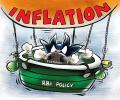
The Reserve Bank of India has increased its retail inflation projection for 2026-27 to 5.1 per cent, up from an earlier estimate of 4.6 per cent. This revision is primarily attributed to mounting input costs, driven by the pass-through of higher global energy prices to domestic petrol and diesel rates, which have seen significant increases since May.
India's total automobile retail sales recorded a significant 9.55 per cent year-on-year growth in May, reaching an all-time high of 25,31,067 units, driven by strong performances in three-wheelers, passenger vehicles, and tractors, despite prevailing heatwave conditions and fuel price pressures.

Indian realty developers are contemplating price increases for ongoing and upcoming projects to offset margin pressures caused by rising input costs and supply chain disruptions, exacerbated by the West Asia conflict. Input and labour costs have surged by 5-12%, directly impacting developer margins, especially for under-construction projects.
Mobile payments pioneer Paytm reported significant growth in its UPI payments business for Q1 FY27, driven by app simplification, AI investments, and a focus on attracting Gen Z customers. The company saw a 45% year-on-year increase in Consumer UPI Gross Transaction Value and a rise of 60 lakh in Monthly Transacting Users, outpacing the industry. Paytm's strategy prioritises customer retention and product innovation, leading to a profitable quarter with strong revenue and EBITDA growth, further supported by AI-led operational efficiencies and an India-focused language model.

A group of experts has voiced significant concerns regarding India's ethanol-blended fuel policy, citing potential negative impacts on land-use, agriculture patterns, food security, groundwater levels, and household incomes. They recommend a return to E10 fuel and a review of the policy's overall benefits versus costs to consumers and the environment.

Indian cement manufacturers, despite a stable Q4FY26, are bracing for significant profitability pressures from Q1FY27 onwards due to escalating input costs, primarily driven by the West Asia conflict's impact on coal and petcoke prices.

Economists widely anticipate the Reserve Bank of India's Monetary Policy Committee will increase the repo rate by 50 basis points, likely split between the October and December meetings, as retail inflation is projected to peak at 6.1 per cent in the third quarter, exceeding the RBI's tolerance limit.

Indian carmakers, including Maruti Suzuki and Kia India, reported robust sales growth in May 2026, with both companies achieving their highest-ever monthly sales despite rising fuel prices. Maruti Suzuki's domestic sales surged to 1,93,535 units, while Kia India recorded 27,586 units, driven by strong demand in mini and compact segments and a shift towards electric and CNG vehicles.

Researchers at IIT Bombay have developed a novel, low-cost, and highly durable catalyst using cobalt, nickel, phosphate, and graphite. This breakthrough material can accelerate both hydrogen and oxygen generation from water, significantly reducing the production cost of green hydrogen by eliminating the need for expensive noble metals like platinum and iridium.

India is making a significant push to establish itself as a global semiconductor manufacturing hub, driven by strategic investments and policy support. The upcoming SEMICON India 2026 event will showcase the country's advancements and ambitions in this critical industry, which underpins virtually all modern electronic devices and has faced global supply chain vulnerabilities.

A government adviser has called for India to reintroduce a petrol variant with a lower ethanol blend, such as E10, alongside the current E20 fuel. This move aims to protect millions of older vehicles, particularly two-wheelers, which may experience performance issues and damage from the higher 20 per cent ethanol blend.

The Confederation of Indian Industry (CII) has urged the Indian government to gradually restore the Rs 10-per-litre cut in special additional excise duty on petrol and diesel over six to nine months. This move aims to relieve pressure on government finances as crude oil prices stabilise, without significantly impacting consumer sentiment.

Hardeep Singh Brar, President and CEO of BMW Group India, has urged state governments like Delhi to remove price caps on road tax benefits for electric vehicles (EVs), arguing that such limits deter luxury-car buyers and hinder the transition to cleaner mobility in pollution-affected regions.

State-run Hindustan Aeronautics Limited (HAL) has delivered LCA Tejas FOC twin-seater trainers and HTT-40 basic trainer aircraft to the Indian Air Force, and Dhruv Next Generation helicopters to Pawan Hans. This significant handover, attended by Defence Minister Rajnath Singh and Civil Aviation Minister K Rammohan Naidu, underscores India's progress towards self-reliance in aerospace, strengthening both military and civil aviation capabilities with indigenous platforms.

The Finance Ministry has refuted allegations that US pressure influenced the decision to levy a 0.4 per cent Merchant Discount Rate (MDR) on select UPI payments. The ministry clarified that the NPCI guidelines prioritise RuPay credit cards on UPI to promote domestic alternatives and ensure a self-sustaining revenue model for smaller domestic companies, countering claims of favouring foreign payment providers.

The Indian government has defended its E20 ethanol blending programme, stating that extensive testing and field experience show no evidence of abnormal engine wear, corrosion, or reduced vehicle life, despite a potential 2-6% reduction in fuel economy.

A Goldman Sachs report indicates that US and Indian equity markets are becoming less attractive due to lower free cash flow (FCF) yields as valuations rise, while European markets offer significantly higher yields. Concurrently, India's top-listed residential real estate developers experienced a moderation in pre-sales in Q1FY27, attributed to delayed project approvals, limited launches, and high year-ago bases, though underlying housing demand remains healthy.

'As long as the vehicle has a flex engine, it is irrelevant if the mixture is 15 per cent or 30 per cent; the performance is the same.'

The Finance Ministry has clarified that the 0.4 per cent Merchant Discount Rate (MDR) on UPI transactions above Rs 2,000, effective October 15, is not expected to increase cash transactions or cause inflation. The ministry also dismissed allegations of US pressure influencing the decision, asserting that the policy aims to promote RuPay credit cards within the UPI ecosystem, and a monitoring mechanism will ensure the MDR burden is not passed on to consumers.

The Indian government has issued a stern warning to industrial users who are reportedly procuring cheaper retail fuel instead of industrial-grade fuel, leading to significant losses for state-run oil marketing companies (OMCs) and potential local shortages. This diversion, driven by a substantial price difference between retail and bulk diesel, is adversely impacting OMCs, which are absorbing daily losses of approximately 550 crore to keep retail prices stable.

The Congress party has criticised the government's new 0.4% charge on UPI transactions above Rs 2,000 for merchants, terming it a "Modi tax". Opposition leaders, including Rahul Gandhi and Mallikarjun Kharge, allege that this move will ultimately burden consumers through price hikes and accuse the government of succumbing to American pressure to dilute India's zero-MDR policy. The government states the charge will support banks and fintechs.
India is significantly expanding its crude oil sourcing to Latin America, with Venezuela emerging as a major supplier, as geopolitical disruptions in the Middle East and the Strait of Hormuz compel the world's third-largest oil consumer to diversify its energy supplies.

Maruti Suzuki India reported a significant 147 per cent year-on-year increase in mini-car sales (Alto and S-Presso) during April-May 2026, reaching 32,341 units, driven by eased production constraints and a surge in demand for CNG vehicles amidst rising fuel prices.

Indian Hotels Company (IHCL) reported a healthy 14.6 per cent consolidated revenue growth in Q1 FY27, largely driven by a robust 17.6 per cent increase in domestic operations, offsetting geopolitical disruptions. Brokerages anticipate sustained growth, with Motilal Oswal Research projecting 12-14 per cent growth in FY27, supported by strong leisure demand and an asset-light expansion pipeline.

Tata Motors Passenger Vehicles (TMPV) reported Q1FY27 results showing significant margin pressures at both Jaguar Land Rover (JLR) and its domestic operations, despite strong volume growth in the India business. Analysts expect these margin headwinds to persist, potentially offsetting gains from increased sales and new launches.

India has no plans to ration fuel supplies despite ongoing disruptions in global energy markets, according to a top oil ministry official. The country has maintained adequate inventories of crude products and LPG while diversifying imports to manage supply risks.

'Healthy double-digit returns are still possible, though a sharp rally is unlikely.'

India's services sector experienced its weakest growth in four-and-a-half years in July, as new business orders, both domestic and export, eased due to intense competition and declining demand. Despite a modest rebound in job creation and improved profit margins, overall business confidence slipped, reflecting a broader slowdown in the economy.

External Affairs Minister S Jaishankar stated that India is in continuous dialogue with both Ukraine and Russia, seeking ideas and suggestions to mitigate or cease the ongoing conflict. Following his visit to Kyiv, Jaishankar reiterated India's stance that the war must end through dialogue and diplomacy, emphasising that trade decisions like oil purchases are not the solution to the conflict.

Indian stock markets experienced a significant sell-off, with the Sensex tumbling over 1,300 points, driven by escalating crude oil prices due to US-Iran tensions and Prime Minister Narendra Modi's call for austerity measures, which amplified investor concerns about India's economic outlook.

Fitch Ratings has warned that India's oil marketing companies (OMCs) could face significant credit pressure if crude oil prices remain elevated, leading to eroded earnings and increased working capital needs due to delayed fuel price pass-through.

As temperatures soar, booking queries have surged by double digits -- going up to 125 per cent -- for destinations like Kashmir, Shillong, Gangtok, Munnar, Leh, Rishikesh, Guwahati, Imphal, Kodaikanal and the Andamans.

Indian companies recorded their highest profit margins in 21 quarters during Q4FY26, reaching 11.3 per cent, primarily due to significant savings from lower employee costs and reduced interest payments, which offset rising raw material prices.

Civil Aviation Minister K Rammohan Naidu announced that public sector oil marketing companies will implement a partial and staggered increase in jet fuel prices for domestic airlines, aiming to protect passengers from steep fare hikes.
Fitch Ratings forecasts a 9 per cent aggregate revenue increase for rated Indian corporates in the current fiscal year (FY27), a stronger outlook compared to the 5 per cent estimated for FY26, which is expected to keep credit metrics stable despite potential global and domestic challenges.

For five Mumbaikars who were teenagers or in their 20s during the 1980s, the decade was not a sepia-toned Instagram filter. It was their everyday life, they tell Rediff's Rishika Shah. And while they remember its limitations, what they seem to miss most is something technology can't recreate -- the unhurried warmth of human connection.

Air India has temporarily reduced its domestic flights by 22 per cent due to the impact of high fuel prices, following a previous reduction in international flights. The airline is offering re-accommodation, date changes, or refunds to affected passengers.

It is about proving that the agency can still deliver when the stakes are high.

India possesses two months of fuel stockpiles and faces no supply concerns despite global energy disruptions, according to Oil Minister Hardeep Singh Puri. However, state-run fuel retailers are incurring losses of up to Rs 1 lakh crore in a single quarter due to elevated crude prices and unchanged retail fuel prices, raising questions about the sustainability of these losses.

'Every period of excessive optimism eventually gives way to a correction, while periods of extreme pessimism often create the best investment opportunities.'
